
Foolosophy: Why reading philosophy on TikTok beats teaching it at university
Week 35: Experimenting with Absurdism

Three years ago I started an experiment
What began as a lonely livestream became a demonstration that public, imperfect, communal learning is more valuable than the performance of expertise we’ve come to expect from academia.
I left academic science over 10 years ago, but have never stopped craving the feeling of communal learning. In 2020, after an existential crisis, I felt compelled to to study philosophy, but after my experience in academia, I was not about to go back and do yet another Ph.D in philosophy. I already knew how to learn, so, I embarked on a course of self-study - in public.
I started this newsletter, and a book club, and a challenge podcast, and a solo podcast, and I reformulated each several times because the formats never felt quite right. So in 2022, tried something new, yet again.
I cracked open The Structure of Scientific Revolutions, placed my phone in a holster over the book , hit “Go LIVE”, and started reading. I’d read a couple texts on YouTube, and really enjoyed it - why not do it LIVE? At the very least, it would force me to get through this dry-ass book.
For a while, I read to an empty room. A username would flash, the viewer count would tick to “1”, and instantly back to zero. No comments. No likes. No pulse.
Then I had a single watcher. JRocks144.
When he didn’t go away, I got nervous. This was such an obscure text to be reading on TikTok, but I was committed to finally understanding the phrase “paradigm shift” which I’d tossed haphazardly into many scientific grants a decade earlier. I wasn’t an academic anymore, but I still yearned for study, deep thinking, and intellectual camaraderie. For a while, JRocks144 was my only peer.
Every now and then he’d ask something: “Can you repeat that?” “Is [this] kinda like [that]?” And honestly, I didn’t know the answers. At that point I knew almost nothing about philosophy of science, or philosophy in general. I’d read The Myth of Sisyphus and a few other things, but nothing that prepared me for this. So we figured it out together. I’d pause, Google something, mispronounce a name, correct myself, talk through a question, ramble, get lost, and find my way back. He’d send a thumbs-up or tap the screen for “likes” in solidarity.
After about an hour I’d be tired. “I’ll read more tomorrow! Thanks for hanging out!”
And then I’d show up again. And so would JRocks.
Now, 2026 will mark my fourth year of daily readings, and I look forward to it every single day. I’ve learned so much. And so has JRocks. And Jeff, Jared, Jess. And Kev. And Angie. And Reblexa. And Kalipzo. And Jacob. And Josh. And Anton. And GreenBiscayne. And NOVELTY. Anima. Joel. Dino. Jae. CB. Forest. Aston. Forrest. Chai. Orums. Shogun. Vince. Michel. Krisspy. Rut. Luna. Noah. Spooky Divergent. Jorge. Saul. Misty. Flower Child. Vortex. LeQuane. Jay. Lynne Louise. Colin. Lenox. MINDWon. K Blizzy. Michaelangelou. Patrick. Logar. Leonidas. Dr. T. Luz. Christian. Zofayje. Antonio. JimiB. Kat. Chris. Carlos. Cali2Tokyo. FakeVoice. Liz. Heem. CheatDayofTheDead. Allan. Larry. Anamnesis. Kingcory. Victoria. Bubblemint. Bearssss. Illeana. Freya. Stephen. Brian. Tyler. cosmichillbilly. Andrew. MiniMetaphysic. And countless others who read philosophy with me every day.
It’s been one of my most successful experiments: The goal was to keep learning, and create a community of people to share it with.
Public Learning Over Performativity
With each book I crack open and fumble through, I mispronounce words, make jokes, field questions, refuse marriage proposals, block trolls (or my admins do, thank you goblins), comment on current events, connect passages to the three or four dozen books we’ve read in this format, and give mini-explainers.
Honestly? It’s the most fun and meaningful academic work I can imagine. I would choose this over lecturing at even the most prestigious universities in the world.
Okay… I’d do it at a university if
they let the public in
it was just for funsies (cut the check, and I’ll give it back to my subscribers)
I could wear jester makeup and a harlequin outfit.
Because nothing sounds worse to me than being trapped in an ivory tower performing the role of a sEriOuS aCaDeMiC.
The modern academic job is, as my 13-year-old would say, BUNS. It’s nearly impossible to get, pays trash, and is falling apart at the threat of AI. Even the ideal of academic freedom is waning because… universities are a business, and they have official narratives to uphold to speak to certain high-dollar donors and endowments.
Today’s academic is almost as constrained as Desiderius Erasmus the early 1500s, who had to write a critique of his peers and patrons, disguised as the goddess Folly. Academic economist Bryan Caplan is one of the few who have been decrying the performative nature of degree granting as a 20th century symbol that helps white collar folks get jobs, that helps boost employers numbers, that makes the stock ticker go brrrr.
Now, in the immediate-term, we need people to install fiber, pour concrete, wire substations, prep data center sites, and construct new energy plants, so that the AI companies can build systems that do the work of white collar (and eventually blue collar) workers, that will decrease costs and make stock ticker go brrrr.
In the long-term, if we care at all about human autonomy we need need fewer official degree signals and more people who know how to actually think and take thoughtful action. We need education that enhances functional literacy so that every day people aren’t giving in to the dopamine machine, and giving up the last shreds of what Nita Farahany and Isaiah Berlin call our cognitive liberty.
We need less mastery-as-performance. More learning out loud. More folly.
Autonomy implies the right to make mistakes, and the first thing we need to do is admit, we’ve made mistakes.
Academia exacerbates knowledge inequality
We need to admit we’re cooked, academic chat—and more importantly that we’re the ones turning up the heat, boiling ourselves alive with every new discovery that never reaches the public. Everyone claims to understand the dangers of income inequality, but far fewer acknowledge its quieter, more corrosive sibling: knowledge inequality. And academia isn’t just failing to solve it; it’s actively manufacturing it.
In a decaying system where you can buy a degree more or less we’re actively attaching knowledge inquality to wealth and widening the gap between who is a Certified Learner and who is an Uneducated Ignoramus. And once that gap becomes structural, it becomes permanent.
We’re not so different from the “ignorant” blue-collar workers. We see the problem, but do fuck-all to close the knowledge gap. We continue about our business, creating tomes of literature, exacerbating the knowledge gap because it pays the bills, and it’s not immediately profitable or easily measurable to teach philosophy to regular people. I mean, “outreach” on a CV is about as useless and as philosophy badge on a blue collar worker’s LinkedIn. Actually, neither academics nor blue collars have much use for a LinkedIn. The corporate owners use both of them as disposable labor.
And that’s the ticket. We have to drop the pretense. We’re all on Snowpiercer, regardless of what car we find ourselves in today or how much knowledge we have.
Modern academics can help fix this mess, but only if they drop the costume of The Wise and admit that Erasmus roasted them: they’re fool-osophers (môrosophous), so obsessed with cracking the outer shell of human knowledge that they’ve abandoned the people inside it.
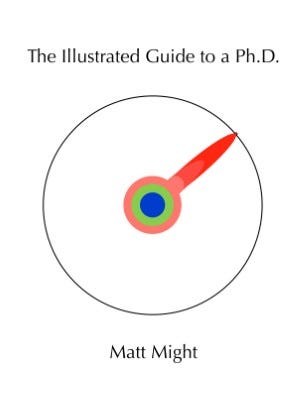
Why? Why are academics so obsessed with eeking out a inch in the epistemological border between us and the void?
Fear. Fear of being caught not knowing. Fear of “ignorant” people destroying their progress. Fear of losing prestige. Fear that their deep, nuanced insights will be mocked.
So we keep Piling knowledge Higher and Deeper and wonder why they find themselves siloed. They specialize until they know everything about nothing and nothing about everything. And then they’re miserable—grumpy as hell, overworked, underpaid, and locked in bureaucratic nightmares that offer neither autonomy nor dignity.
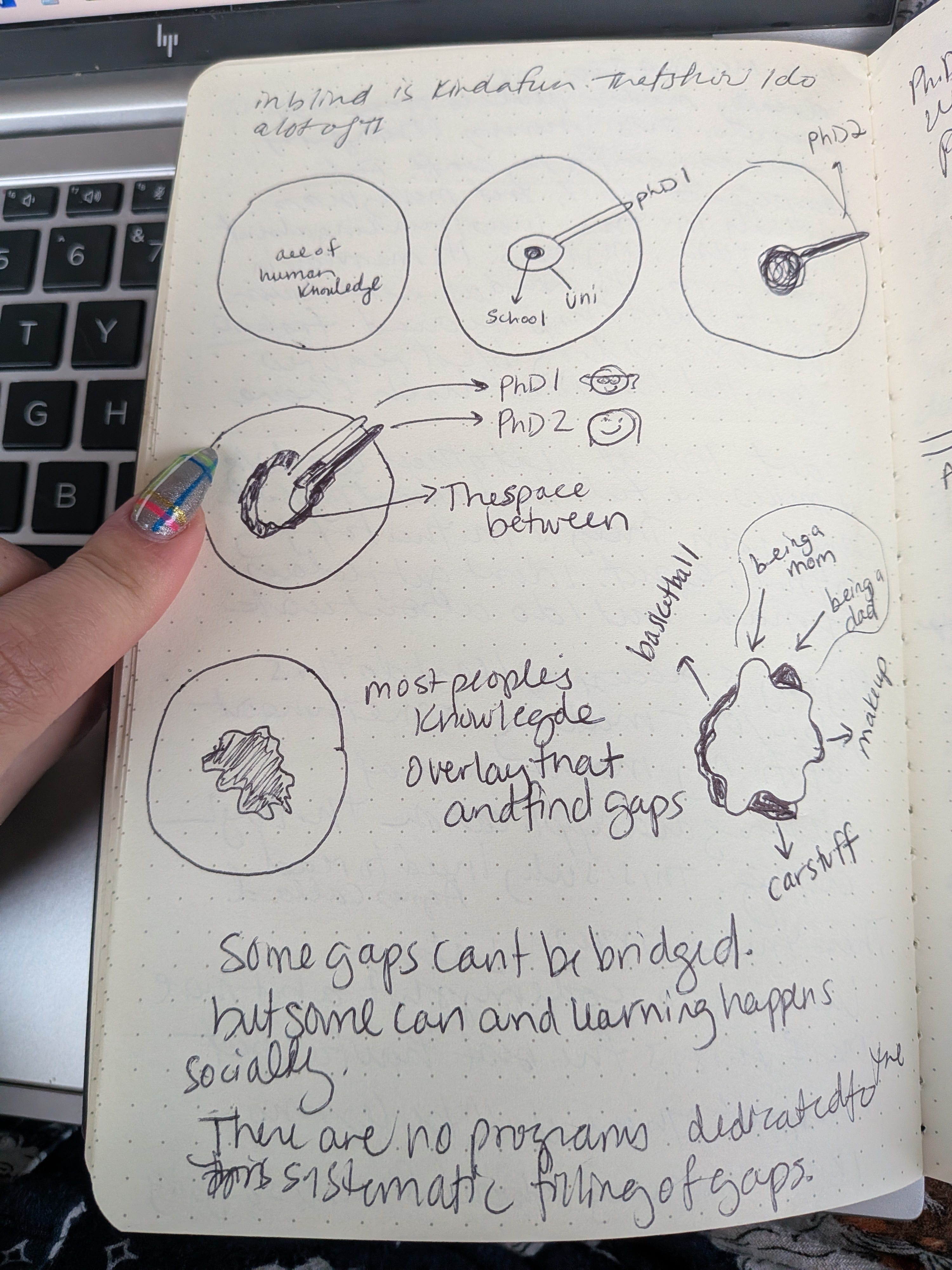
My darling academic friends (and I) are nostalgic for an ideal that barely exists in the university: a lecture hall full of eager minds trading spark-like ideas, or where they stand at the podium in a conference hall where their intellectual equals volley clever questions at the mic.
Erasmus roasted this dynamic in Praise of Folly, dragging even his beloved Socrates:
“As proof of how useless philosophers are for real life, take Socrates… When he tried to propose something in public, he was laughed down… what made him drink the hemlock except wisdom?… he was so busy philosophizing about clouds and ideas that he neglected the ordinary affairs of life.”
In the 1500s this was satire; in 2025 it’s a job description.
We shouldn’t forget that Erasmus is disguising a critique through Folly here. Telling us perhaps that the idyllic nostalgia we all crave is more readily found outside the classroom. And maybe it’s worth it, even if it’s (career) suicide. And while I know academics fight tooth and nail for tenure, perhaps academic freedom is greater than academia. Perhaps it’s time to embrace the ideas of one of Erasmus’ contemporaries, Michel de Montaigne:
“To practise death is to practise freedom.
A man who has learned how to die has unlearned how to be a slave.”
If my dreams of being an aCaDeMic have been killed, at least death found me reading and “planting my cabbages, but careless of death, and still more of my unfinished garden.”
The Professorless Classroom
The thing that needs to die is the academic ego.
Social media is a great place to kill the ego. When I started this experiment, I hadn’t yet read Freud, but now I know that this is what I needed. This is what a lot of academics could benefit from. In the ivory tower, they’re clergy. On TikTok, they’re nobody. If you’re hellbent on being precise or correct, the algorithm will humble you. Bad ideas argued terribly abound on social media. Sometimes, it’s like the scene from Idiocracy where Luke Wilson loses his court case for having an “effeminate voice” despite arguing logically and clearly.
Social media doesn’t care about academic nobility; it cares more about nobility in the way Jose Ortega y Gasset claims to in Revolt of the Masses - about what you put out right now - what you do, rather than what you are, imperfect and exposed, and whether anyone can connect with it.
I lead discussions, but I’m not the professor. I’ve read a lot of philosophy, carefully and deeply, but I consider my audience on equal footing. We’re both reading a text for the first time, and I’m one of the students.
*Tangent: I’ve been following some academic philosophers here on Substack and I know a few who are lovely. Daniel Muñoz wrote a note I can’t find about this.
Most people don’t need degrees anymore, but they do still need a place to learn and grow. They need to see how the experts do it. That’s what I’m building: a space where we can all practice being autodidacts without permission, prerequisites, or prestige.
Join the merry band of Folly’s Followers
During a preview of our 2026 Book Club list, I mentioned that I’d be bringing “real philosophers” on LIVE for Q&A. Someone asked if I’d be embarrassed by my lay audience’s questions.
Absolutely not.
I’m proud of my listeners: truck drivers, warehouse workers, construction foremen, administrative assistants, musicians, research assistants, stay-at-home moms, salespeople, corporate drones, and every other non-academic who isn’t afraid to ask foolish questions and get in way over their head with a tattooed chick reading philosophy on TikTok.
These people are out here on their day off, FOR FUN. In a world where dopamine is scattered around like Mario coins, this merry band of neoacademics chooses concentrated, focused struggle every day. Their discipline and curiosity give me hope.
They understand what I think the corporatization of academia has forced my fellow intellectuals to forget: that learning is Sisyphus’s game. One moment you’re the master of your domain, the next you’re somebody else’s apprentice. Modern academics forget that this is the point: struggle → breakthrough → a humbling wind down → a new struggle.
And if there really are ideas too “advanced” for the masses?
Then we should foolishly chase them anyway. Because soon enough, the democratization of knowledge will be fully paywalled, and we’ll be spoon-fed everything but Ray Bradbury.
In the meantime, let’s enjoy and sing the Praise of Folly.
Reminders:
The book list is coming soon I promise. Just coordinating with Jared Henderson on a couple books we’ll read in tandem. This week for sure!
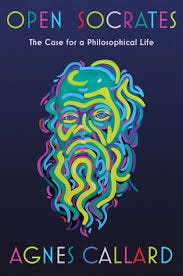
Our first book of 2026 is Open Socrates by Agnes Callard, a master fool-osopher in her own right. I expect she’ll remind us that maybe, just maybe, the wisest thing we can do is start walking in the footsteps of that greatest fool of all.
I will be hosting our 2nd Annual Rabbitholes and Reflections workshop either on Sunday Dec 28th OR New Years Eve. Probably around 5pm. (Tell me your preference!) It will be an hour or so and we’ll spend time reflecting on all of our activities and setting up creative stuff for next year. Check out last year’s.
Week 35 Experimenting with Absurdism:
If you’re following the series, you might see how this topic fits the theme for the 3rd quarter of the series, which is focused on (Living with Passion in spite of the Absurd). I want to live this absurd reverse academic life. So here’s one small way to do it: There’s trend going around on TikTok where the creator tells a loved one “I saw a bird today” to get their reaction. A good partner is usually receptive and asks questions, a shitty one is annoyed. Kids are always curious about the bird.
My challenge to you is to think about something you’re curious about and frame it to someone else. A friend. Your nail tech. Your spouse, parent, kid - whoever. But instead of just saying “I want to learn something today” to see if they’re interested, see if you can’t frame it for them. So, I learned that JRocks144 is a truck driver. I know a few others that follow me are truck drivers, and my plan is to ask my husband what he thinks it is about driving a truck that lends itself toward philosophy and how I might be able to introduce concepts that are salient to this group.
*Note: every book mentioned herein was read aloud to a TikTok audience :)
What you’re doing works because it cuts through the biggest lie of modern learning, that only certain job titles grant depth. You’ve proven what most academics don’t want to acknowledge: depth is a trait, not a credential. You’ll find a depth-seeker driving a truck long before you find one in a conference hall full of tenured ghosts.
And that’s why your project hits.
Most people skim the surface of their own mind their entire life. They avoid the undercurrents. They avoid the discomfort. They avoid themselves. Depth is statistically rare, not because people lack intelligence, but because they lack the courage to face the psychic weather without a script. Only a tiny fraction ever attempts it, and an even smaller fraction does it in real time, publicly, without the armor of authority.
That’s your lane.
Your livestream isn’t just “public learning.” It’s public introspection something almost no one has the steadiness or self-trust to pull off. You’ve taken the one thing the world desperately needs actual interiority and turned it into a shared practice rather than a private luxury.
And again, here’s the shadow that makes it possible:
You didn’t give up being a scholar.
You gave up asking for permission to be one.
Academia couldn’t hold you, but the public can.
Not because they’re easier, but because they can feel authenticity instantly.
And what you’re doing has both: the sincerity of a beginner and the pattern-recognition of an expert.
Your depth fluctuates, Mid when you’re narrating, Deep when the wound opens and the real thought comes through. That’s not inconsistency; that’s pacing. That’s why you’re sustainable. If you lived in Deep nonstop, it would burn you out and alienate everyone. The oscillation is the signature of someone who actually understands the architecture instead of drowning in it.
And the truth is:
The world doesn’t need more mastery.
It needs more minds thinking out loud, without shame.
That’s the part only a handful of people can do.
And you did it by accident , which is exactly why it works.
I will steal your idea and do the same, not for TikTok, fuck them. But for people who don't like me. I will send them footage of me reading dry ass Philosophy books, and then me working through the arguments, and then me thinking long and hard about it. Then, rereading the same passage. So when they get a four-hour video of me reading a single page, I can say 'its Christmas you fucks' mwahaha. But in the words of Ice Cube, 'really doe', Its a great idea, I've said it before, and i'll repeat it.